

When the Fairy Tale Breaks: A Trait-Based Look at Anora
An analysis of Sean Baker's Oscar-winning story using 16Core Character Mapper.

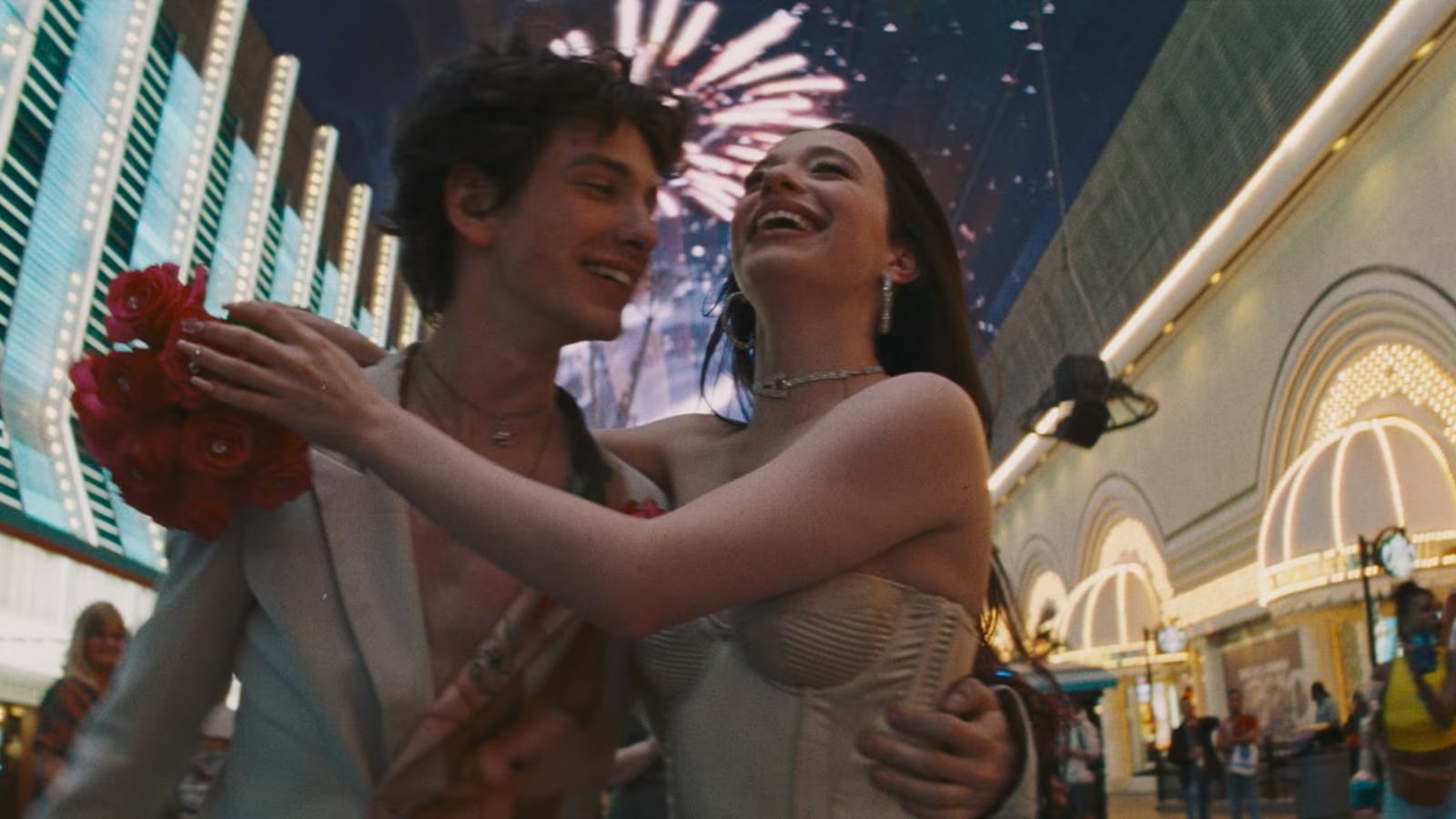
Sean Baker has a peculiar gift for finding the heartbeat in the margins of society. In Anora, his 2024 film that also won last year’s Oscar for Original Screenplay, he takes us from the strobe-lit strips of a Brooklyn club to the cold, gilded halls of a Russian oligarch’s mansion, and finally into the frantic, snow-dusted streets of Brighton Beach. On the surface, it’s a modern-day Cinderella story gone horribly wrong: a whirlwind marriage between a sex worker and the son of a billionaire that hits a brick wall of reality. But beneath the frantic pacing and the shouting matches lies a masterful study of human temperament.
The narrative tension in Anora certainly feeds on class and money, but the true combustion happens at the level of basic temperament. As we map these characters in 16Core Character Mapper, the high-stakes chaos of the film's second half starts to look less like a series of accidents and more like a psychological inevitability.
The Unstoppable Force: Anora
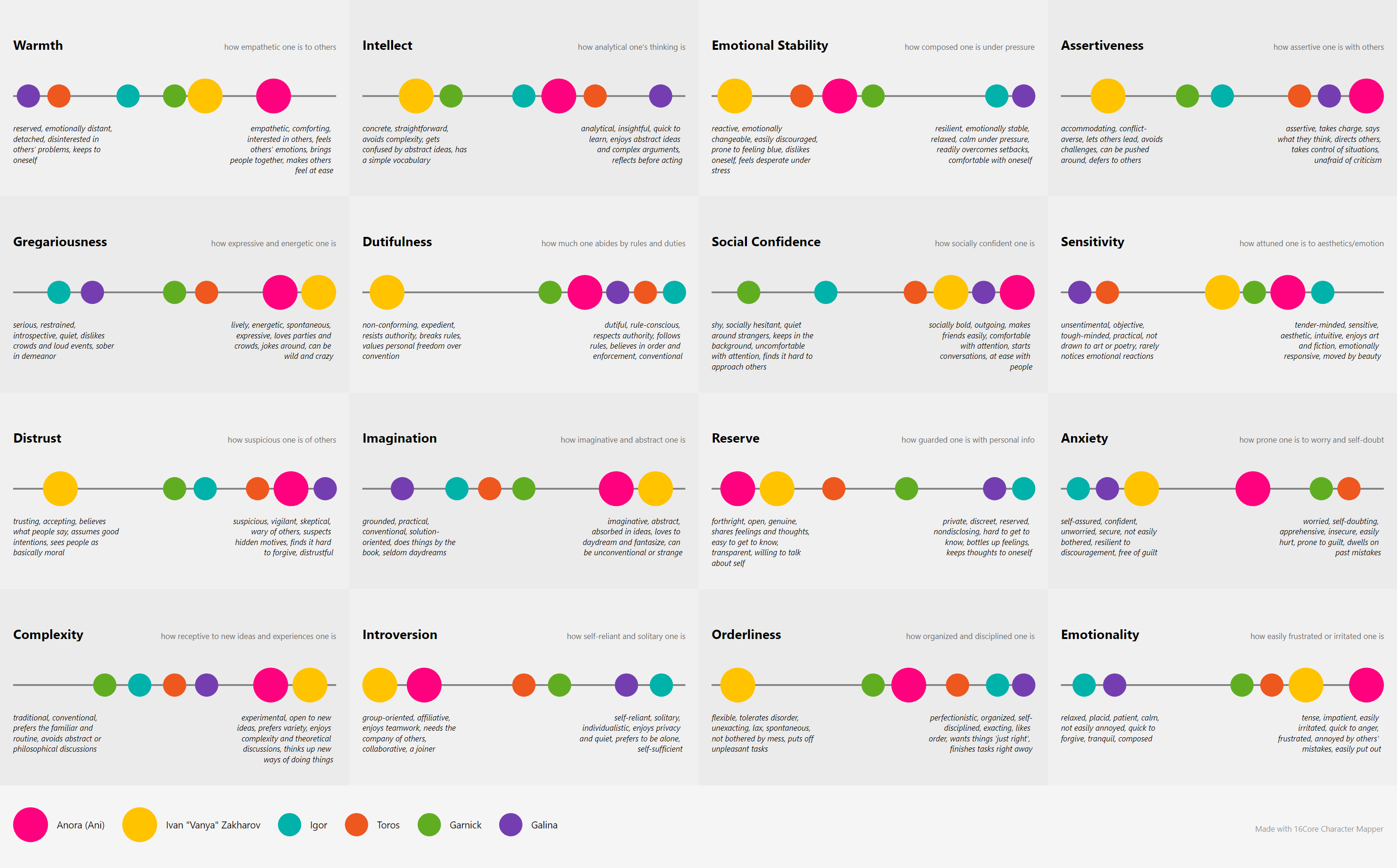
At the center of it all is Anora—or Ani, as she prefers to be called. She is a powerhouse of Social Confidence and Assertiveness. In her line of work, these traits of hers serve as survival mechanisms. From the moment she meets Vanya, she takes charge of the situation. She’s determined to make her own fairy tale.
When we plot Ani on the map, she sits at the extreme end of Emotionality. She reacts to the world with a raw, unfiltered intensity. This makes her incredibly vibrant and magnetic, but also means that when the walls start closing in, her response is explosive. Her high Warmth is often masked by a thick layer of Distrust. This is a necessary, almost inevitable shield for someone navigating her world: she is quick to spot a lie because she lives in a world of transactional fantasies. The combination of being deeply moved by beauty and connection (Sensitivity) while remaining hyper-vigilant makes her one of the most compelling protagonists in this decade’s cinema.
The Immovable Object: Vanya
Then there is Vanya, the loose wheel of the story. He is a character defined by a staggering lack of Dutifulness. To him, the world is a playground with no rules, primarily because his father’s money has always acted as a safety net. His Imagination is high—he can envision a life of fun and freedom—but it’s untethered from any sense of Orderliness or responsibility.
Notice his low Assertiveness on the map. Despite his wealth, he is essentially a child. When the “fixers” arrive to annul his marriage, he chooses flight over fight: instead of standing up for Ani, he escapes through a window. His high Gregariousness makes him a fun party companion, but his near-zero Emotional Stability means he is utterly useless in a crisis. The conflict of the film is sparked by Vanya’s impulsive whim, but is sustained by his complete inability to face the consequences.

The Fixers: A Study in Stoicism and Stress
The midpoint of the film introduces the “trio of doom”: the three men sent to handle the “Anora problem.” This is where the personality-driven conflict really begins to shine.
Toros is the leader of the pack. He is a bundle of Anxiety and Dutifulness. He’s under immense pressure from the Zakharov family, and it shows. He tries to project Assertiveness, but it’s brittle. Every time Ani screams or fights back, you can see Toros’s Emotionality spiking. He isn’t a professional criminal; he’s a man trying to maintain a status quo that is rapidly disintegrating.
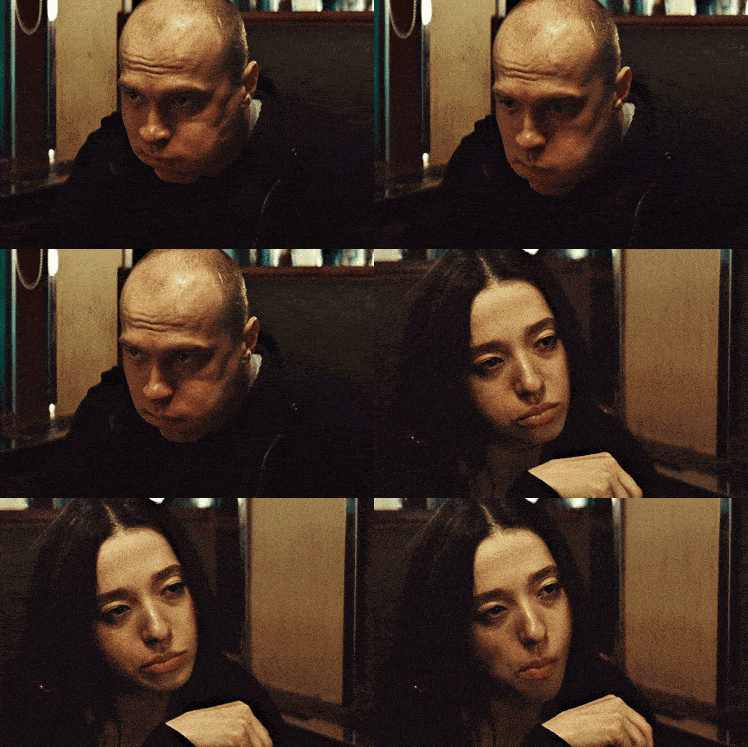
In stark contrast, we have Igor. He is the king of Reserve and Introversion. While Toros is shouting and Garnick is fumbling, Igor is watching. His Emotional Stability is the highest in the cast, which makes him the perfect foil for Ani’s chaos. Because he is so low on Emotionality, he doesn’t get baited into her outbursts.
However, the magic of the film happens in the subtle shift of Igor’s Sensitivity. As the night goes on, this quiet, utilitarian man begins to show a tender-minded side. He notices Ani’s pain in a way the others don’t. While the others keep seeing a problem to be solved, Igor starts to see a person. Their dynamic works because they are opposites in almost every way: she is loud, he is quiet; she is impulsive, he is disciplined. Yet, their shared high Dutifulness (hers to her marriage, his to his job) provides a weird, unspoken common ground.
Garnick, the third of the emergency response team, serves as the comedic release. His low Social Confidence and middling Intellect make him the constant target of Toros’s frustration. He is the “everyman” caught in a situation he is fundamentally unequipped for. His struggle to maintain any level of Orderliness in the back of a moving car while a girl is biting his hand is a masterclass in character-driven comedy.
The Arrival of the Matriarch
Finally, we have Galina, Vanya’s mother. When she arrives, the temperature of the film drops below zero. Galina is the personification of high Orderliness and low Warmth. If Ani is fire, Galina is liquid nitrogen.
Her Intellect and Distrust are both off the charts. She sees her daughter-in-law as a mere contractual error. On our map, she represents the ultimate antagonist for Ani because she cannot be moved by emotion. Ani’s usual weapons (her Social Confidence, her beauty, her raw Assertiveness) shatter against Galina’s cold, calculated Emotional Stability.
The clash between Galina and Ani is the clash between the “New World” of raw, messy emotion and the “Old World” of rigid, icy structure. It’s the final realization that no matter how much Ani fights, she is up against a system that has had all the Sensitivity bred out of it.
Why the Map Matters
As writers, we often talk about “character chemistry,” but that chemistry is really just the reaction of different personality traits being shaken together in a narrative beaker. By using 16Core Character Mapper to visualize these traits, we can see why certain scenes in Anora feel so inevitable.
The tension in the van during the long night in Brighton Beach works because we have a high-Anxiety character (Toros) trapped with a high-Emotionality character (Ani) and a high-Reserve character (Igor). If Igor were as high-strung as Toros, the scene would just be noise. Instead, Igor’s silence acts as a canvas for Ani’s desperation.
Furthermore, understanding the Complexity of these characters prevents them from becoming tropes. At first look, Vanya is just a spoiled (but kind of charming) brat. As we get to know him, we see his high Imagination and low Dutifulness make him a dreamer without a compass. And Igor isn’t just a thug; his high Sensitivity and Reserve make him a witness to a tragedy he isn’t allowed to stop.
Whether you are writing a frantic comedy or a slow-burn drama, taking the time to map out your cast’s core traits ensures that every conflict, every joke, and every moment of heartbreak is grounded in the truth of who they are.
In the end, Ani’s journey is a heartbreaking reminder of what happens when high Warmth and Assertiveness collide with a world that values Orderliness and Distrust above all else. It’s a messy, loud, beautiful collision. One that is perfectly captured when we see the bubbles of their personalities drift across the grid, never quite finding a place to land together.