

Core Series #01: Understanding Warmth
A guide to mastering the empathy engine of your cast with 16Core Character Mapper through examples from film, TV, and literature.

This post marks the beginning of a new monthly series here on Mapped Out, where we’ll focus on one specific trait at a time. This series is designed to be more educational than our usual deep-dives, focusing on how you can apply the 16Core Character Mapper trait system to your own stories. While the tone is a bit more instructional, we’ll still be using some of our favorite iconic characters from film, TV, and literature to show exactly how these psychological dimensions manifest on the page and screen.
How much does your character actually care about the people standing right in front of them? This is what Warmth answers in 16Core Character Mapper’s trait grid.
We often think of “good” characters as those who are simply… nice. But Warmth is a much more specific psychological engine. It measures a character’s emotional investment in others: the drive to comfort, to nurture, and to feel the weight of another person’s struggles. On the grid, Warmth lets you fine-tune how much space your protagonist (or antagonist) actually has in their heart for other people’s well-being.
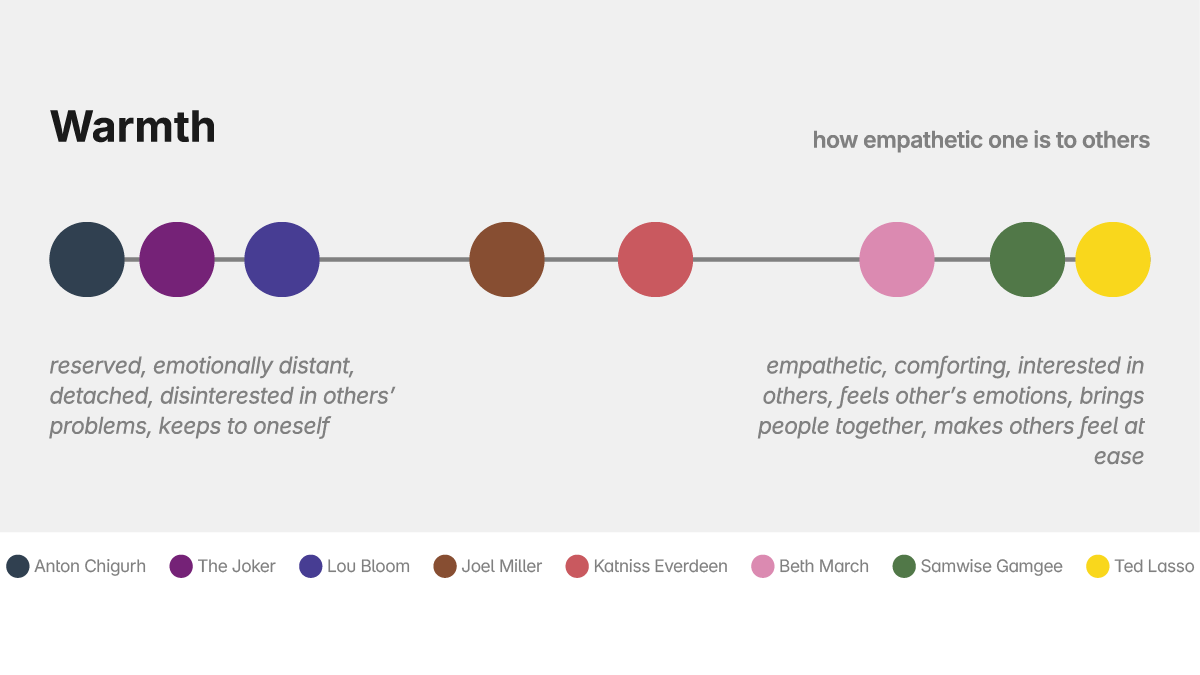
To see how this plays out in practice, let’s look at the Warmth trait across a range of familiar characters.
The Low End: The Detached
We begin at the very bottom of the scale, where empathy is nonexistent. These characters view the world through a cold, clinical, or even predatory lens. They aren’t necessarily villains by default (though many are) but they all share a lack of interest in the emotional states of those around them.
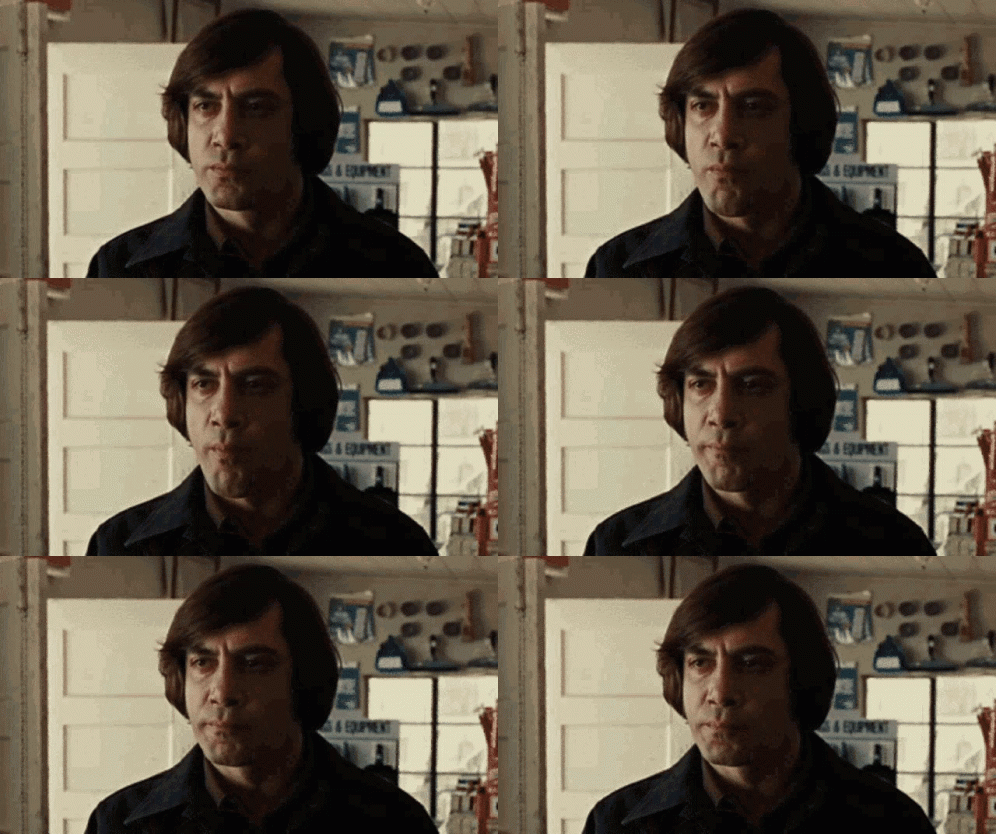
At the absolute zero of the scale, we find Anton Chigurh (blue), the hitman from No Country for Old Men. Chigurh is the most striking example of a character with no Warmth whatsoever. He doesn’t kill out of passion, anger, or even joy. He’s a force of nature, as indifferent to the person he is about to shoot as a lightning bolt is to the tree it hits.
You can see this chilling neutrality in the famous gas station scene. When he asks the owner to call the coin toss, he isn't mocking the man, and he isn’t angry at him. He is simply calculating a variable. To Chigurh, a human life is no more significant than that coin.
Moving just a fraction up the scale, we encounter the chillingly nihilistic Joker (purple) in The Dark Knight. While still devoid of genuine care, his lack of Warmth acts as a weapon rather than a void. He finds the irony in human suffering. He understands how empathy works only so he can use it to destroy the fair society of Gotham’s citizens.
Climbing slightly higher, Nightcrawler’s Lou Bloom (indigo) is a paradigm for low Warmth. He’s highly intelligent and articulate, but he views people strictly as data points. He mimics the language of empathy as a social lubricant, yet remains entirely unaffected by the pain of others.
The defining moment for his score is when he films a fatal car crash before the police arrive. Instead of checking for a pulse, he physically drags the victim’s body across the pavement to get better lighting for his news footage, treating the dying man as nothing more than a prop in a framing issue.
The Middle Ground: The Pragmatists
Many of the most compelling protagonists sit in the middle of the Warmth line. These characters are capable of deep love, but they have built-in filters. Their empathy is often a limited resource, reserved for a select few or suppressed for the sake of survival.
Joel Miller (brown) from The Last of Us starts his journey as a man who has intentionally dampened his Warmth. After a traumatic loss, he views the world through a detached, hardened filter. To Joel, people are either threats or cargo. We see this low starting point early on when he coldly checks his watch while refusing to pick up a family on the side of the road during the outbreak.
However, his arc is defined by the slow, painful thawing of his long-frozen empathy. As he grows closer to Ellie, his Warmth begins to re-emerge, proving that these traits are not just static markers but can be the very foundation of a character’s transformation.
Crossing the midline, we see a fascinating study in nuanced Warmth in Katniss Everdeen (red) from The Hunger Games. Katniss keeps her heart behind Kevlar, shoving Peeta against a wall the moment she suspects betrayal. Yet, her entire journey begins with a massive act of sacrificial empathy: volunteering for her sister.
Her Warmth is a localized fire. She cares deeply for Prim and Rue, but she can be chillingly pragmatic when dealing with everyone else. This friction between her natural empathy and her survival instinct is what makes her such a rich character to follow.

The High End: The Nurturers
Finally, we reach the top of the scale: the “empathy engines”. These characters are the emotional glue of their respective stories. When someone is upset, they feel a physical, internal compulsion to fix it.
Beth March (pink) from the novel Little Women introduces us to this high-altitude empathy. She is the quiet heartbeat of the March household. Her Warmth manifests as a gentle, almost selfless desire to keep peace and care for the less fortunate, even when it costs her own health. She represents the tender-hearted pole of this trait, where the suffering of others is felt as deeply as one’s own.
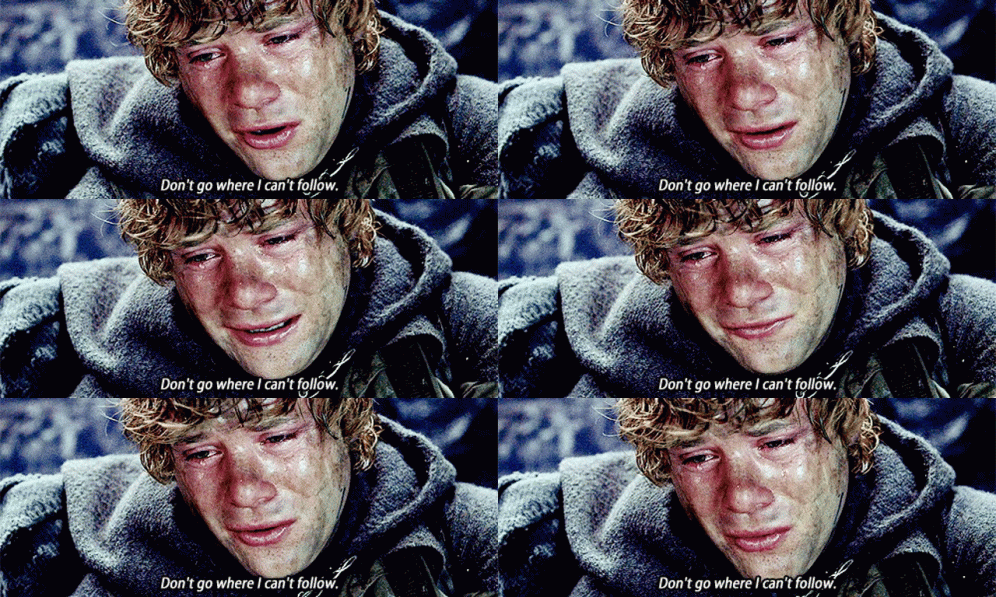
To her right in the line, we find Samwise Gamgee (green) from The Lord of the Rings. While Frodo carries the literal burden of the Ring, Sam carries the emotional weight of their journey. His concern for Frodo’s hunger, sleep, and spirit drives his every action.
The ultimate manifestation of his high Warmth happens on the slopes of Mount Doom when, seeing Frodo collapse, Sam ignores military strategy to offer his own back, insisting that while he can’t carry the Ring, he can carry his friend. He isn’t seeking glory or even the destruction of evil for its own sake; he is seeking to comfort his friend through hell.
And at the rightmost edge of the line sits Ted Lasso (yellow), the gold standard for high Warmth. His entire coaching philosophy revolves around the emotional health of his players. He bakes biscuits to win over a cold boss and uses “The Diamond Dogs” as a support group for his staff. For Ted, every person is a soul worth tending to, and he is never too busy to care.
Engineering Conflict through Warmth
Understanding where your characters sit on the Warmth scale is vital for creating organic tension. If you place a high-Warmth character like Ted Lasso in a room with a low-Warmth character like Lou Bloom, the conflict writes itself. One will be trying to find a human connection while the other is looking for a transactional advantage.
In 16Core Character Mapper, you can visually check if your cast is too similar. If every character is high in Warmth, your story might feel too sentimental; if they are all low, the narrative might feel alienating.
The goal isn’t to make everyone “nice”. The goal is to understand the empathy engine of your cast so you can predictably drive them into meaningful, personality-driven collisions. Whether you are writing a cozy mystery or a gritty survival thriller, the way your characters feel for one another will always be the hook that keeps your readers turning the page.
However, always remember that Warmth is only one component of a personality. A character exists as the sum of how all 16 traits intersect. A detached protagonist who is also high in Dutifulness will behave very differently than one who is a chaotic rebel. You need the whole board to see the whole person.
This new series is your roadmap to that complete picture. Next month, we’ll be breaking down Intellect, and over the coming months, Core Series will cover the entire 16-trait grid so you have the knowledge to master your own story’s psychology.
You don’t have to wait to get started, though. You can begin mapping your characters right now in 16Core Character Mapper by using the descriptive hints located below each trait line. Click the button below to learn more and download the app for free.
What other characters that are defined by Warmth can you think of?