

Core Series #02: Understanding Intellect
Explore how different processing styles drive narrative tension and discover how to map your cast's cognitive landscape using 16Core Character Mapper.

This post continues our new monthly series here on Mapped Out, where we’ll focus on one specific trait at a time. This series is designed to be more educational than our usual deep-dives, focusing on how you can apply the 16Core Character Mapper trait system to your own stories. While the tone is a bit more instructional, we’ll still be using some of our favorite iconic characters from film, TV, and literature to show exactly how these psychological dimensions manifest on the page and screen.
When we talk about a character’s Intellect, it is easy to fall into the trap of thinking we are just measuring their IQ or counting the PhDs on their wall.
In the framework of 16Core Character Mapper, however, Intellect is less about being smart and more about a character’s processing style. It represents the specific way a person digests information. It’s the difference between someone who views their surroundings through a framework of abstract theories and mental puzzles versus someone who sees things exactly as they are.
A high score on this trait suggests a character who is naturally drawn to complexity. They enjoy deconstructing systems, finding patterns, and solving riddles that others might not even notice.
On the other side of the line, we find characters who are concrete, literal, and pragmatic. They trust their five senses over abstract concepts and often view theoretical discussions as a waste of time.
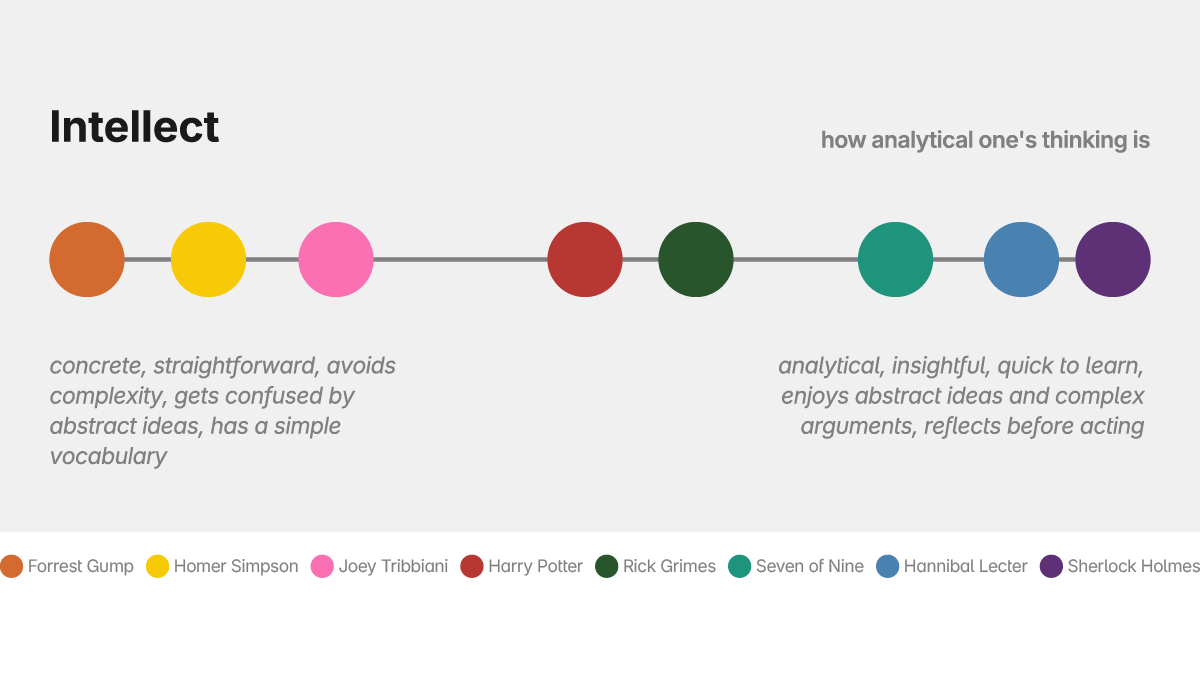
To understand how this spectrum creates character voice and conflict, let’s look at how this trait manifests across a gradient of iconic characters, moving from the literal-minded to the hyper-analytical.
The Concrete Thinkers: Living in the “Now”
At the left side of the Intellect line, we find characters who operate almost entirely in the concrete world. They do not burden themselves with subtext, hidden motives, or complex future projections.
A perfect example of this is Forrest Gump (orange). He’s the ultimate literal-minded character. He has zero filter for subtext, irony, or complex social theory. He sees the world exactly as it is, without any added layers of sophistication or hidden meaning. When he is told to “run”, he runs. He doesn’t stop to analyze the geopolitical implications of his running, nor does he worry about the physiological limits of his body. He simply processes the command and executes it.
There is a profound beauty in this low Intellect score. It allows him to navigate life with a sincerity that more analytical characters find impossible to achieve. He doesn’t get bogged down in the “why” of things, which allows him to succeed through pure, unadulterated action.
To his right, we find Homer Simpson (yellow, obviously). For Homer, complexity is a literal enemy. If a concept cannot be explained in five seconds or less, his brain tends to shut down or wander off to think about donuts. This creates a certain type of narrative engine. He creates chaos because he lacks the foresight to see how his immediate actions affect a larger system. He doesn’t think in terms of “if-then” logic. He thinks in terms of “want-now.” His processing is entirely reactive and physical.
Comedy is full of (and many times based on) low-Intellect characters. Outside of animation, one of the most iconic ones is Joey Tribbiani (pink) from Friends. You could say Joey is the “dumb” of the group, but this description doesn’t qualify as a complete statement in our 16-trait framework. He just has a low Intellect score in terms of his processing style.
He takes things at face value. If someone uses a metaphor, Joey might look for the physical object being described. He values the immediate and the tangible over any abstract discussion. This creates a specific type of cognitive friction. When the other characters are debating complex social dynamics or careers, Joey is focused on whether there is pizza in the fridge.
In your own writing, these characters act as grounding rods. They see the simple truth that the more intelligent characters have missed because they were too busy looking for a system.
The Practical Middle Ground
Moving toward the middle of the line, we encounter the tactical thinkers. These characters are capable of planning and strategy, but their thinking is always tethered to immediate survival and utility. They aren't interested in knowledge for knowledge's sake; they want to know how that knowledge keeps them alive.
We see this processing style clearly in Harry Potter (red). Harry is certainly not stupid, but he isn’t the academic powerhouse of his trio—that role belongs to Hermione (who would map much higher on Intellect).
Harry operates on instinct and practical application. He is intelligent enough to navigate the wizarding society, but he doesn’t live in his head. He lives in the moment. When faced with a problem, he doesn’t reach for a book on magical theory. He reaches for his wand and tries to figure it out as he goes. This makes him relatable to the audience because his way of thinking mirrors our own balanced approach to life.
Rick Grimes (green) from The Walking Dead occupies a similar space in this nuanced middle ground. Rick is a smart man, a strategist, and a leader. However, his Intellect is applied rather than theoretical. He isn’t interested in the philosophy of the zombie apocalypse or the abstract “why” of it all. What he’s interested in is the logistics of the next fence. He has enough abstract thinking to plan a revolution or a tactical ambush, but he is fundamentally anchored in physical reality. He is a meat-and-potatoes thinker who uses logic as a tool for survival rather than for its own sake.

The Analysts: Efficiency and The Complexity Trap
As we cross into the high end of the scale, we meet characters whose processing style is fundamentally analytical. You put them in a situation and they instantly see data, variables, and efficiency.
Seven of Nine (teal) from Star Trek: Voyager is a quintessential example of high Intellect. Her mind, enhanced by Borg technology, processes information at a rate impossible for an average human. Upon entering a room, she immediately calculates structural integrity, analyzes energy readings, and determines the most efficient path to the exit.
Seven of Nine provides a fascinating nuance that justifies how a high-tech cyborg can sit lower than non-enhanced humans on the Intellect line. While she possesses immense computing power, Intellect measures processing style—specifically the gradient from hard facts to abstract theory. Seven masters facts and efficiency. She’s a deductive powerhouse, taking existing data and processing it flawlessly.
However, she remains tethered to that data. The extreme edge of the scale requires the ability to make intuitive, abstract leaps without variables present. Seven requires the variables. She represents the peak of logical efficiency, while the top of the scale is reserved for pure abstraction.
This also brings us to a critical distinction: the boundary between Intellect and Complexity.
High Intellect denotes analytical capability, whereas Complexity measures a character’s openness to new ideas, ambiguity, and unconventional experiences. Even though Seven of Nine can solve warp core breaches in her head, she maps quite low on Complexity. She views human metaphors as inefficient, finds social rituals baffling, and is irritated by ambiguity. She prefers the rigid structures and known variables of the Borg over the chaotic, experimental nature of humanity.
This distinction allows for the creation of distinct characters, such as a mathematical genius who refuses to try new foods. Seven’s arc largely revolves around her struggle to embrace the inefficient complexity of human life, even while her Intellect remains superior to those around her.

The Abstract Masterminds
Finally, at the extreme top of the scale, efficiency gives way to theory generation. Here we find the characters for whom the entire world is a puzzle waiting to be solved. These are the masterminds who view people not as humans, but as variables in a grand equation.
Hannibal Lecter (blue) from The Silence of the Lambs exemplifies the terrifying side of high Intellect. He possesses a surgical mind that dissects human psychology as easily as he dissects... well, everything else.
He doesn’t just kill. He composes. He views human behavior as a series of intricate, sophisticated patterns that he can manipulate for his own amusement or curiosity. He is never surprised, because he has already calculated the probabilities.
Similarly, Sherlock Holmes (purple) represents the pinnacle of the abstract/analytical processing style. Facts are only useful to him if they can be slotted into a complex deduction. If a piece of information doesn’t challenge his mental processing, he’s likely to ignore it entirely. He famously didn’t care whether the Earth circled the Sun or vice versa because that specific fact had no bearing on his work. His brain is a finely tuned machine that filters out knowledge without practical application, allowing him to focus on abstract connections.
His “mind palace” is the ultimate visual representation of a High Intellect score. While a concrete thinker like Forrest Gump sees a smudge of mud on a shoe, Sherlock sees the soil composition, correlates that with the weather patterns of the last 24 hours, and concludes the wearer has been in Sussex.
For these characters, the abstract connection is more real than the physical object. This makes them brilliant, but often isolates them. Their high Intellect creates a natural barrier between them and the rest of the cast, as they are literally thinking in a language that others cannot speak.
Engineering Conflict Through Processing
Understanding where your cast sits on this line is vital for engineering dialogue. A conversation between a high-Intellect character and a low-Intellect character is a goldmine for “talking past each other”: one is speaking in abstractions and metaphors while the other is speaking in concrete facts.
Imagine a scene where a high-Intellect scientist is trying to explain a complex disaster to a low-Intellect politician. The scientist is talking about “tectonic shifts” and “probability matrices”. The politician just wants to know if the bridge is going to fall down. This gap in processing style creates natural, character-driven tension that doesn’t require a villain to exist. It is simply two different brains trying to solve the same problem using two different languages. Whether you’ll turn this into a comedy or a thriller, it’s entirely up to you.
Using 16Core Character Mapper to visualize these gaps helps you ensure that your characters aren’t just saying different words, but are actually thinking in entirely different ways. If you find that your protagonist and antagonist are both at the top of the Intellect scale, you have a classic “battle of wits”. This is a story about chess moves and foresight. However, if one is high and the other is low, you have a clash of perspectives. One is trying to outthink the other, while the other is simply smashing through the obstacles because they don’t see the complexity of the trap.
Both are compelling, but they require very different types of writing. By mapping these out, you can stop guessing and start intentionally designing the cognitive friction that makes a story move forward.
Discover more from Core Series
You can find all published articles of the series here.