

Madison Avenue on the Couch: A Psychological Autopsy of Sterling Cooper
Decoding the friction of Mad Men with 16Core Character Mapper

In the pilot episode of Mad Men, Don Draper famously tells a client “Advertising is based on one thing: happiness.” But as anyone who has watched the series knows, the show itself is actually built on the friction between who people pretend to be and who they actually are. The setting of a 1960s ad agency provides a perfect petri dish to observe how specific personality traits clash against a changing social landscape.
Using 16Core Character Mapper, we can peel back the polished veneer of the Madison Avenue elite to see the raw psychological machinery that drives their triumphs and their messy, whiskey-soaked failures.
The Mystery of the Creative Director
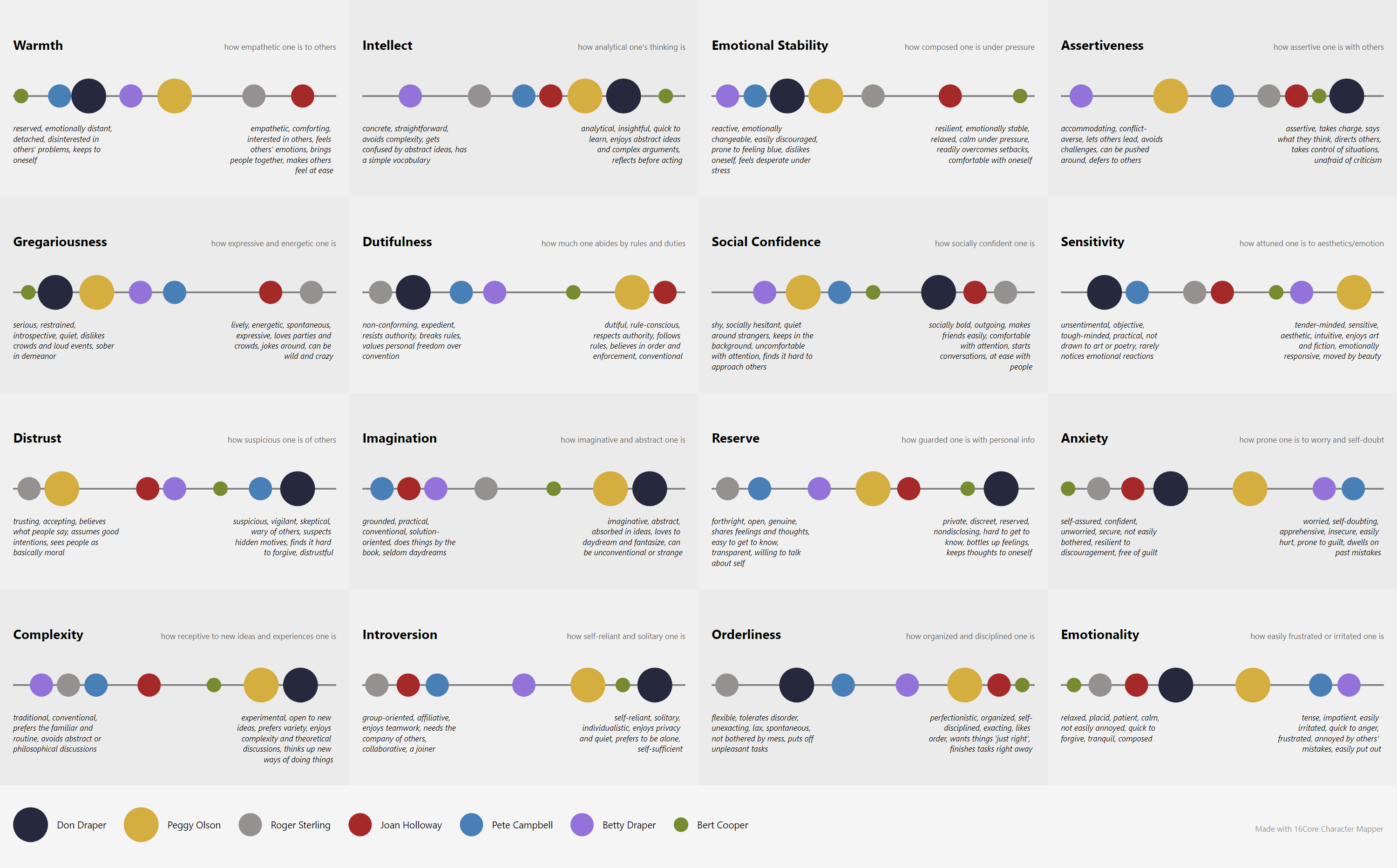
The character of Don Draper (black) is often discussed in terms of his mystery. He is the man who isn't there, a hollow suit filled with someone else's memories. On our map, this translates to a staggering level of Reserve and Distrust. Don is a vault. He is psychologically incapable of being “known” because he views every personal revelation as a security breach. This high Distrust is the engine of his domestic failures. You cannot have a successful marriage with someone who views intimacy as a tactical weakness.
Don’s genius, however, comes from his high Imagination and Complexity. He looks like he just sells cigarettes or slide projectors, but in reality, he uses his creative vision to manufacture a feeling of wholesome history. He is an experimental thinker who prefers the complex and theoretical over the concrete facts of a product. This allows him to create a manufactured nostalgia for a perfect, stable American life that he never actually lived. Given his own traumatic and secret past as Dick Whitman, Don is essentially selling a dream of a “yesterday” that exists only in his ads. He weaponizes a sense of belonging that he has never truly felt.
This internal conflict is further fueled by a surprising gap between his Assertiveness and his Dutifulness. Don is highly dominant; he takes charge of every room and directs others with a terrifying level of control. Yet, his Dutifulness is remarkably low. He is expedient, someone who resists authority and breaks the rules of the very society he helps to define. He is a non-conformist hiding in the most conformist industry on earth, and that tension is what makes him a wild card that no one, not even the audience, can truly pin down.
The Striver and the Socialite
Pete Campbell (blue) is often the most frustrating character for viewers. He is a high-frequency transmitter of Anxiety and Emotionality. Unlike Don, who hides his turmoil behind a mask of Reserve, Pete wears his desperation like a cheap cologne. In an office environment that prizes a “stiff upper lip”, Pete’s inability to hide his feelings makes him an easy target. He is constantly seeking external validation that his background doesn’t actually provide.
Pete’s conflict with Roger Sterling (grey) is a perfect example of personality-driven drama. Roger has massive Social Confidence and high Gregariousness. To Roger, life is a cocktail party he was born to host. He was born into the firm, hence he doesn’t worry about his place in the world. Pete, despite his pedigree, feels like a perpetual outsider. His high Anxiety forces him to constantly strive, while Roger’s low Anxiety allows him to be lazy and charming. Pete hates Roger because Roger makes success look effortless. Roger dislikes Pete because Pete’s frantic energy ruins the vibe of the office. The conflict is baked into their DNA: asking them to share a client is enough fuel to the fire.
The Ascent of Peggy Olson
While the men of Sterling Cooper often rely on inherited status, the women must rely on something far more meticulous: the weaponization of their own personalities.
Peggy’s (yellow) journey reflects this clearly. She begins the series with high Introversion and low Social Confidence. She is the quiet secretary in the corner. However, as she moves to the creative side of Sterling Cooper, her Intellect and Imagination become her greatest assets.
Peggy and Don share a high level of Complexity. They speak the same language of metaphors and subtext. They both find more meaning in the work than in the social rituals of the office. But their maps diverge sharply on Dutifulness. Peggy actually cares about the craft in a way that is tied to her identity and her sense of “doing the right thing”. Don will walk out of a meeting if he feels like it; Peggy will stay up all night because she feels a duty to the mission.
This difference is where their relationship eventually cracks. Peggy grows to resent Don’s lack of discipline, while Don is often baffled by Peggy’s need for approval. As the series progresses, Peggy’s Assertiveness grows—not because she becomes an extrovert, but because her Intellect gives her the leverage she needs to demand a seat at the table. By the later seasons, she shares Don’s level of Complexity and Imagination, but she maintains a much higher level of Orderliness. She becomes the “adult in the room”. The conflict between them often boils down to this: Don wants the freedom to be creative whenever he feels like it, while Peggy’s Dutifulness demands that the work be done right every single time.
The Glue and the Glass Ceiling
Joan Holloway and Betty Draper represent two different ways of handling the pressures of the era.
Joan (red) is the queen of Orderliness and Dutifulness. She understands exactly how the machine works. While the men are having three-martini lunches, Joan is managing the logistics of a multi-million dollar business (and whatever these three-martini lunches bring and needs to be dealt with). Her high Assertiveness is her primary weapon. In a time when women were expected to be accommodating, Joan used her commanding presence to run the agency.
However, her map reveals a tragic tension. She is high in Sensitivity, meaning she is deeply attuned to the emotional weight of her choices. She isn’t a robot. She feels the slights, the disrespect, and the objectification deeply. But because she is also high in Reserve, she rarely lets the men see the toll it takes. She is a woman of high Emotional Stability who is forced to navigate an unstable world.
In contrast, Betty Draper (purple) has high Emotionality and Sensitivity, but she lacks Joan’s Assertiveness and Social Confidence. Betty is trapped by her own temperament, and by what the society back then demanded of “pretty women” and housewives.
She was raised to be a model, a porcelain doll of suburban perfection. Her internal world, though, is a storm of dissatisfaction. Because she scores low on Assertiveness, she doesn’t know how to ask for what she wants. Instead, her frustration manifests as passive-aggression. Betty’s high Anxiety and Don’s high Reserve create a total communication blackout. She needs reassurance (Warmth), but he is a man who hides in the shadows of his own mind.
The Zen of the Corner Office
Finally, we have Bert Cooper (green). With a high score in Intellect and the highest possible score in Emotional Stability, Bert is the “oracle” of Madison Avenue. Nothing rattles him. Not the loss of a major account, and not even the discovery that his star creative director is a fraud.
What makes Bert truly fascinating is the contradiction in his Sensitivity. While he is emotionally cold and detached (low Warmth), he has a very high Sensitivity to art and beauty. He doesn't care about your personal problems, but he will spend a fortune on a Rothko because it makes him feel something abstract and profound.
It is this specific combination of detached perception and extreme Orderliness that fuels his leadership style. Because he sees the truth of an object (whether it is a painting or a creative director) he doesn't need to bark or bluster. His Assertiveness is quiet and absolute; he knows exactly what things are worth, which gives him a terrifying level of clarity. He knows Don’s secret, but his high Complexity allows him to see that Dick Whitman is just as talented as Don Draper. He’s the only person who can truly manage Don because he doesn't approach him with Warmth or Anxiety, but with cold, intellectual pragmatism.
Writing from the Inside Out
When a scene feels flat, it often is because the characters are too similar. If everyone in a room has high Social Confidence, the dialogue will be fast and witty, but there might not be any real tension. But if you drop a character with high Introversion and high Distrust into that same scene, the entire dynamic changes. The pauses become just as important as the words.
True conflict occurs when internal maps are oriented so differently that a common language becomes impossible to find. Don Draper doesn’t want to be a mystery; he just has such a high baseline of Distrust that honesty feels like a death sentence. Pete Campbell doesn’t want to be annoying; he just has such a high baseline of Anxiety that silence feels like failure.
When you are starting your next project, try mapping your cast in 16Core Character Mapper. Look for the dead zones, where everyone is too similar. Look for the clash points, where two characters are on opposite ends of a trait like Orderliness or Emotionality. You might find that your plot is already there, hidden in the gaps between your characters’ personalities. And if you’re stuck on a character arc, take a look at the grid. The answer to what they’ll do next is often buried in who they’ve been all along.