

Beyond the Gun: The Psychological Gears of The Godfather
The personality-driven conflict of the Corleone family, mapped and analyzed with 16Core Character Mapper.

There is a reason why The Godfather remains the gold standard for character writing. Francis Ford Coppola and Mario Puzo constructed a cast that feels like a perfectly tuned, yet dangerously unstable, machine. The Corleone family operates like a complex clock; every gear has a specific shape, and the story moves forward because those shapes don't always fit together smoothly.
By plotting these characters on 16Core Character Mapper, the mechanics of their tragedy become much easier to see. We can look past the Mafia tropes and see the actual psychological foundations that make these people feel so real.
The Patriarch’s Paradox
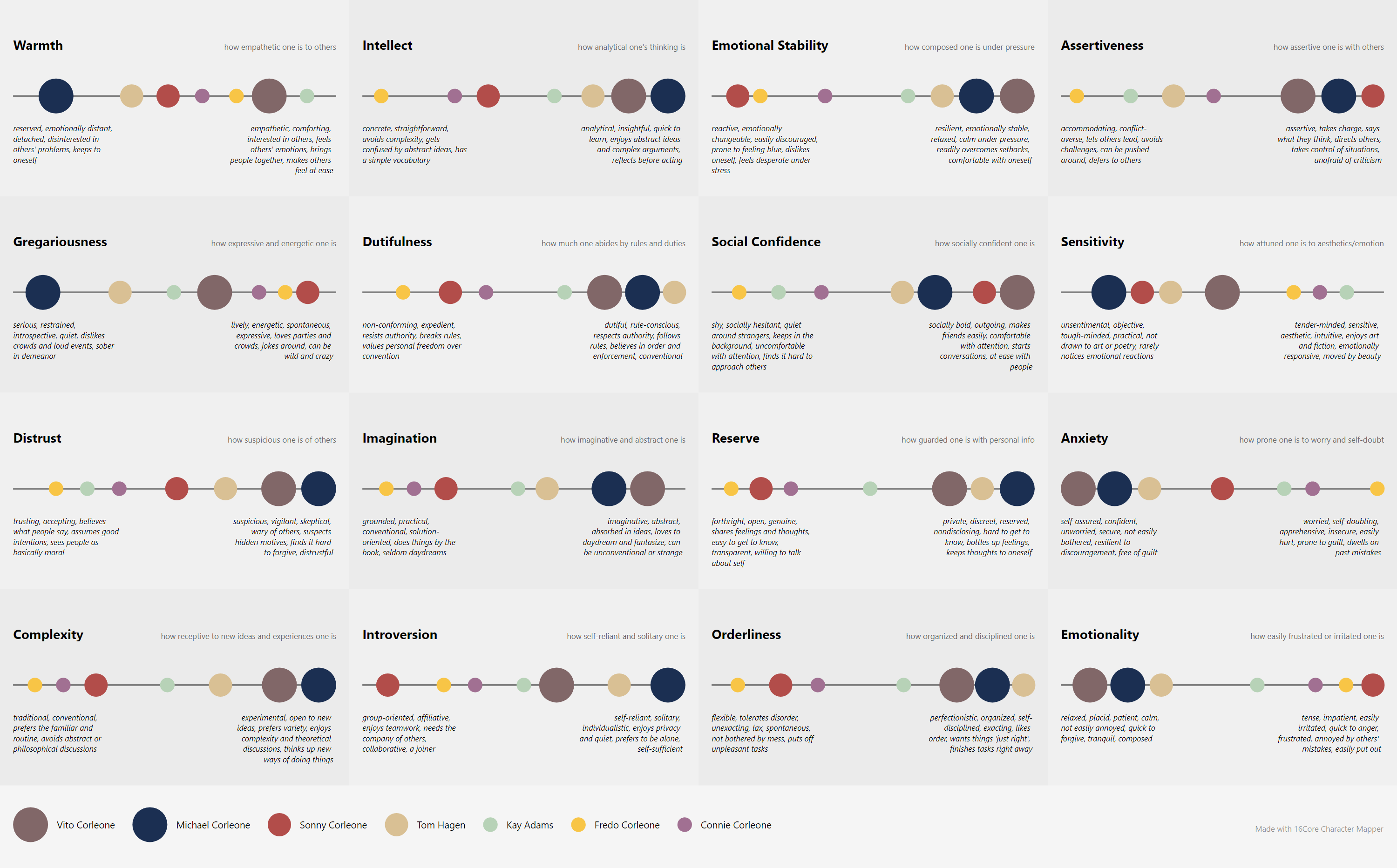
Vito Corleone (sepia) is the anchor of the narrative, and his placement on the map explains why he survived so long. He occupies a rare space defined by high Intellect and extreme Reserve. He is the ultimate don because he has mastered the art of being private and discreet. He doesn't show his hand, and he doesn't react out of impulse.
However, Vito’s secret weapon was his Warmth. Unlike the cold, corporate version of the mafia Michael eventually builds, Vito sits further toward the empathetic end of the scale. He genuinely understands people. He builds bridges and makes others feel seen, which turned his associates into family. He managed to be both a private, guarded strategist and a man who valued human connection.
The Trajectory of Michael: Choice vs. Disposition
Michael Corleone’s (navy blue) journey is a masterclass in the tension between choice and disposition. At the beginning of the story, Michael is determined to stay out of the family business (“That’s my family, Kay, it’s not me”).
However, on the map we see that Michael’s civilian heroics were driven by the same traits that would eventually make him a ruthless Don: high Dutifulness and Orderliness. Earlier in the story, his Dutifulness was directed toward the Marine Corps and the state. When his father is attacked, that same trait simply shifts its target toward the family.
Michael shares his father’s Intellect and Reserve, but as the story progresses, he moves toward a much more tough-minded stance on the Sensitivity scale. By the end of the film, Michael has stripped away the Warmth that his father possessed. He is more efficient than Vito, perhaps even more intelligent, but his placement on the map shows a man becoming increasingly isolated. He has the Orderliness to run an empire, but lacks the empathetic bridge-building that kept the family truly together.
The Tragedy of Temperament: Sonny Corleone
The most famous dynamic in the film is the contrast between the brothers. Sonny (red) is a character driven by high Emotionality and peak Assertiveness. He is reactive, loud, and prone to frustration. While these traits make him a terrifying force in a street fight, they also make him predictable. His enemies don’t need to outsmart him; they just need to trigger his temper. His inability to move toward the “placid” or “relaxed” end of the Emotional Stability scale means he can be baited, which is exactly how his enemies trap him at the causeway.
The Volatility of Connie Corleone
Connie (purple) represents the psychological collateral damage of the family business. Early in the story, her placement is characterized by high Anxiety and high Emotionality. She shares Sonny’s reactive nature but lacks his Assertiveness, leaving her vulnerable to the whims of the men around her.
On the map, we see her as a reactive (not proactive) character—someone whose life is shaped by the actions of others rather than her own agency. Her trajectory is a fascinating study in how a personality can be pushed to the brink when surrounded by the extreme Distrust and Reserve of the Corleone men. Her eventual transformation into a more hardened, “private” version of herself in the later films is a direct response to the environment we see mapped out here.
The Rational Engine: Tom Hagen
Tom Hagen (tan) occupies a unique space on the map. As the Consigliere, his Dutifulness and Orderliness are off the charts. He is the “rule-conscious” executor who respects authority and values tradition.
However, Tom’s position on the Assertiveness scale is much lower than the Corleone bloodline. He is accommodating and often lets others lead, which is precisely why he is a great advisor, but a weak wartime consigliere. He lacks the killer instinct (high Assertiveness) required to direct others in a crisis. When Michael pushes him aside, it isn’t because Tom isn’t smart (his Intellect bubble is right up there with the best of them) but because his personality isn’t built for the aggressive, proactive maneuvers Michael demands.
The Outliers: Fredo and Kay
Then we have Fredo (yellow). Looking at the map, he’s often pushed toward the “apprehensive” and “socially hesitant” poles. His high Anxiety and lower Social Confidence create a character who is constantly seeking validation but lacks the internal security to earn it. His placement explains his betrayal: he wasn’t looking for power as much as he was looking for a way to stop feeling small in a family of giants.
Kay Adams (mint) serves as our emotional barometer. Positioned with high Sensitivity and Complexity, she is the only character who most persistently questions the theoretical and moral implications of the family’s business. Her disposition is fundamentally at odds with the Reserve and Distrust required to survive in the Corleone world. As Michael moves further into the “private” and “wary” sections of the grid, the distance between his bubble and Kay’s becomes an unbridgeable chasm.
Lessons for Storytellers
When you map a cast like this, you realize that conflict is something that these characters were built for. If Sonny had Michael’s stability, the war with the Five Families would probably have ended in a week. If Michael had Vito’s warmth, he might have kept his family together.
As writers, we can use these 16 traits to ensure our ensembles are balanced. By intentionally spacing your characters out, giving one high Sensitivity while another is tough-minded, or making one expedient while another is dutiful, you create a narrative that moves itself. The trait grid shows you why these people can never truly get along.
Map your own characters with 16Core Character Mapper. Click the button below to learn more and download!