

Chasing the Green Light: A Psychological Map of The Great Gatsby
Analyzing the core traits of F. Scott Fitzgerald's cast with 16Core Character Mapper.

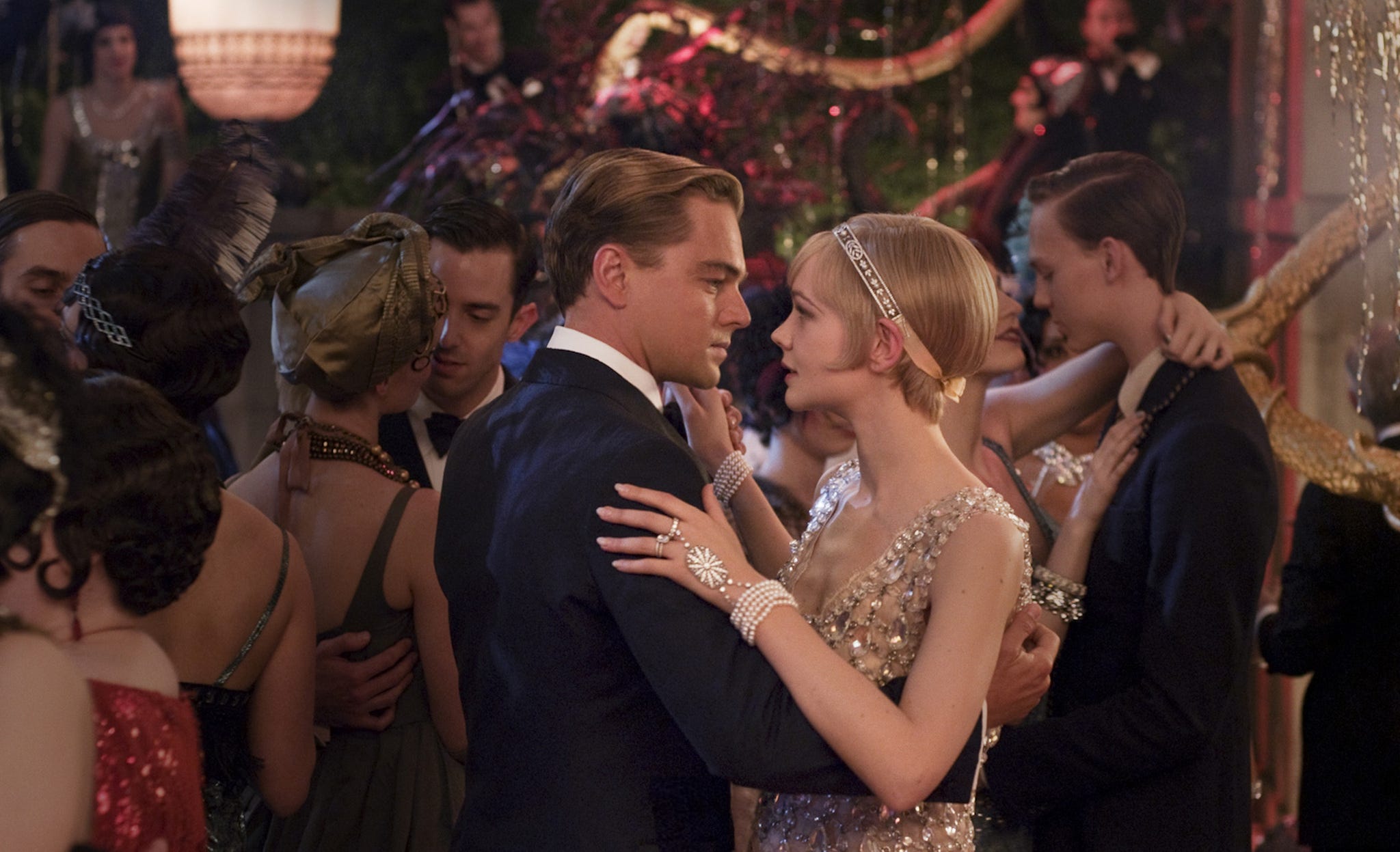
F. Scott Fitzgerald’s The Great Gatsby is one of the most dissected pieces of literature in history, usually analyzed through the lens of social class or the crumbling American Dream. However, when you look at the story from the perspective of a writer trying to build a cast, it becomes a fascinating study in psychological friction. The wreckage at the end of that sweltering summer stems from a collision of personalities that were never meant to occupy the same space.
By plotting these characters on 16Core Character Mapper’s grid, the inevitability of the ending becomes clear. We often talk about character arcs, but in this novel, the characters are largely static. They are who they are, and their fixed dispositions act like tectonic plates grinding against one another until the earth finally gives way.
The Reliable Witness: Nick Carraway
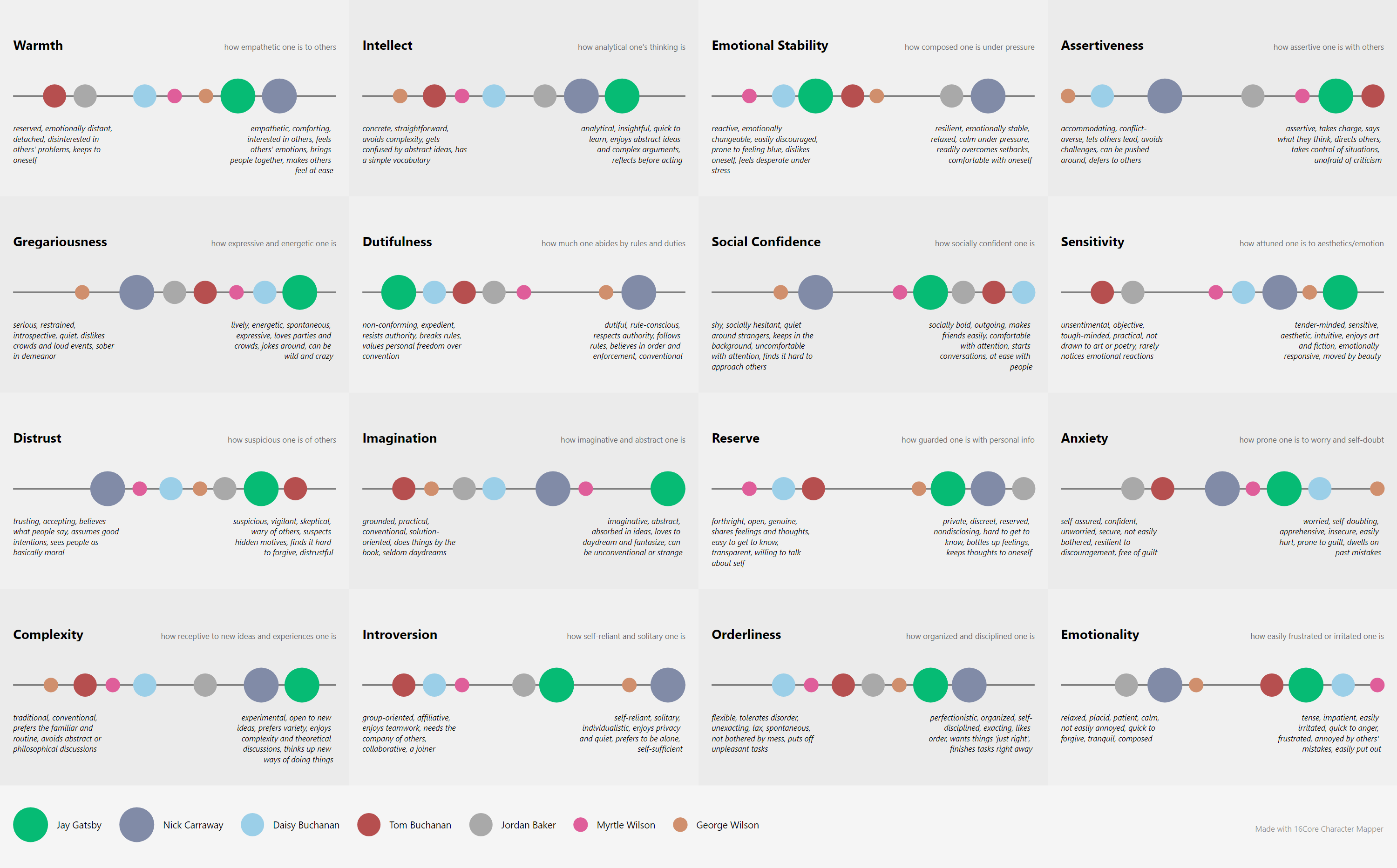
Nick (muted blue) is our way into this world, and Fitzgerald carefully constructed him to be the perfect observer. When we map Nick, his most prominent features are high Introversion and Reserve. He stays on the fringes of Gatsby’s legendary parties, glass in hand, watching. He is the quintessential observer who absorbs every detail but remains personally guarded. This makes him the ideal clean slate for the reader to inhabit.
His high Dutifulness acts as his moral compass. He values order and rules, which is why he eventually becomes so disgusted by the lawlessness and moral decay of West Egg. However, his low Social Confidence creates a passive protagonist. He sees Tom’s infidelity and Gatsby’s obsession, yet he rarely intervenes. His Emotional Stability allows him to remain the calm center of the storm, but it also creates a distance. He is “within and without,” and that psychological distance is exactly what allows the tragedy to unfold right in front of him without him ever raising a hand to stop it.
The Architect of Illusion: Jay Gatsby
Gatsby (green) is a character built entirely on the trait of Imagination. He lives in a world of symbols and possibilities rather than cold facts. His life is a creative project; he transformed James Gatz into Jay Gatsby through sheer force of will. This high Imagination is his greatest gift, but it also creates a massive blind spot. He believes that if he can dream it vividly enough, he can overwrite the past.
His Complexity is equally high. Gatsby doesn’t follow the routine paths of Old Money success. He is an experimentalist, a man who built an empire on shady deals and bootlegging because the traditional rules of Dutifulness didn’t interest him. However, his Social Confidence is a clever performance. He has trained himself to say “Old Sport” and host massive galas, but when he is finally alone with Daisy, he reveals high Anxiety and intense Emotionality. He is terrified that his illusion won’t hold. He is sensitive to every shift in Daisy’s mood because his entire identity is tethered to her approval.
The Predators of East Egg: Tom and Daisy
Tom Buchanan (red) represents the hard, unyielding wall that Gatsby’s dream eventually hits. Tom’s profile is a study in high Assertiveness and low Sensitivity. He is a tough-minded individual who sees the world in terms of power and possession. He doesn’t have the Imagination to understand Gatsby’s romanticism. To him, Gatsby is simply a threat to be identified and eliminated.
Tom’s high Distrust makes him a natural detective. While everyone else is busy enjoying Gatsby’s champagne, he’s looking for the lie. He treats everyone—including his wife and his mistress—with a total lack of Warmth. He’s the psychological antagonist because his traits are the exact opposite of Gatsby’s across the most part of the map. Where Gatsby is open, imaginative, and sensitive, Tom is closed-off, literal, and cruel.
Daisy (light blue) is the tragic middle ground. She shares Gatsby’s high Emotionality, but she lacks his drive. Her profile shows a dangerous combination of high Social Confidence and low Emotional Stability. She knows how to be the center of attention, but she falls apart under pressure. Her high Anxiety makes her crave security. When the conflict between Tom and Gatsby reaches its peak at the Plaza Hotel, Daisy chooses Tom. Not because she loves him; she chooses him because his high Assertiveness and high status provide a shield for her own fragility. She is careless because her low Dutifulness allows her to walk away from the mess she helped create.
The Spark in the Valley: The Wilsons
The tragedy needs a catalyst, and we find it in the Wilsons. Myrtle Wilson (pink) is a burst of raw Emotionality and high Assertiveness. She is desperate for a life of luxury and will do anything to get it. She’s low in Reserve: loud, vibrant, and demanding. This makes her a useful tool for Tom, but she is entirely disposable to him because of his low Warmth.
George Wilson (brown) represents the final, tragic breaking point of the story. George is high in Anxiety and Dutifulness. He is a man who wants to follow the rules and do right by his wife, but he is constantly beaten down. When he discovers Myrtle’s betrayal, his Emotional Stability snaps. His low Complexity means he sees the world in very simple, black-and-white terms. He looks at a billboard and sees the eyes of God demanding justice. The collision between George’s despair and Gatsby’s high Imagination is the final, inevitable spark that burns everything down.
Engineering Narrative Tension
When you are writing your own stories, mapping your cast helps you identify where these points of friction exist. If you have a protagonist with high Sensitivity and an antagonist with low Sensitivity, you have a built-in conflict that will color every conversation. The personalities are fundamentally at odds, so the drama arises naturally from who they are. You don’t have to manufacture events to create tension; you simply put these two people in a room and let their traits do the work.
The showdown at the Plaza Hotel provides a perfect example of how these traits interact. As the temperature in the room rises, so does the interpersonal friction. Tom’s Distrust is on full display as he relentlessly grills Gatsby about his past, searching for every crack in the “Oxford man” persona. We watch Gatsby’s carefully curated Social Confidence evaporate, replaced by a visible Anxiety that he can no longer hide once his secrets are dragged into the light. Throughout the entire confrontation, Nick’s high Reserve keeps him anchored to his role as the silent witness, observing the wreckage without feeling strong enough to stop it. By mapping these specific dispositions in 16Core Character Mapper, you can clearly see why each character behaves exactly as they do in a crisis. This level of detail keeps your cast consistent and ensures their reactions are grounded in their established psychological profiles.
Making a character map also prevents the common problem of “cloned” characters. In The Great Gatsby, Jordan Baker (grey) could have easily been another version of Daisy. But Fitzgerald gave Jordan high Reserve and high Emotional Stability. She is cool and cynical where Daisy is frantic and emotional. These subtle differences ensure that every character feels like a distinct individual with their own internal logic.
We return to West Egg year after year because we recognize the psychological truth of these characters. We’ve met the “Toms” of the world, and we have felt the pull of the “Gatsbys.” Gatsby’s tragedy was rooted in his belief that he could use his Imagination to change the world around him. He failed, but the way he failed—driven by his Sensitivity and his high Complexity—is what makes him one of the most compelling characters in literature.
The next time you’re working on a scene and it feels flat, try mapping the personalities of your cast in 16Core Character Mapper. You might find that the conflict isn’t missing—it’s just waiting for you to tap into the right trait. Whether it’s a flickering green light or a heated argument in a hotel room, the best stories always come down to the map of the human heart.