

Why Dunder Mifflin Scranton Never Runs Out of Conflict
An analysis of The Office (US) using 16Core Character Mapper

When we think about The Office, we usually think about the cringe-inducing meetings in the conference room, or the elaborate pranks Jim pulls on Dwight. But if you look under the hood of the writing, the show is a brilliant example of how personality-driven conflict can sustain a narrative for years.
The reason the Scranton branch feels so alive is because the characters are positioned at extreme ends of the psychological spectrum, making a productive workday almost impossible—a dynamic that becomes crystal clear when visualized through 16Core Character Mapper.
Michael Scott: The Needy Nucleus
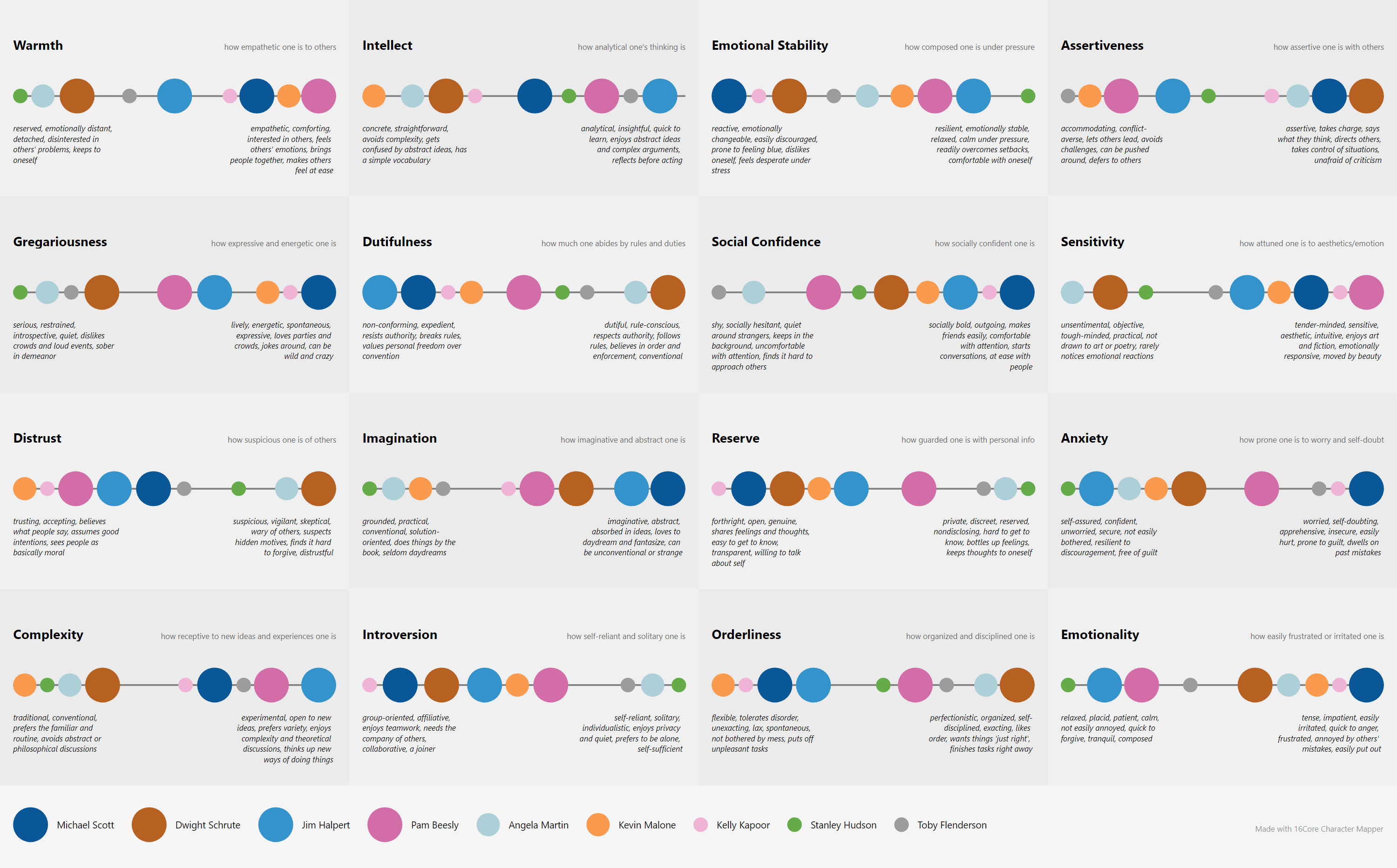
Michael Scott (dark blue) is the gravitational center of the office. He is a fascinating study: a massive spike in Warmth and Gregariousness is coupled with a near-zero level of Emotional Stability. He desperately wants to bring people together and win the “World’s Best Boss” award in every conversation, but he lacks the internal filter to do so effectively.
When Michael enters a scene, he is a character whose high Social Confidence and high Anxiety are constantly at war. He is bold enough to start a “Beyoncé always says” speech but anxious enough to spiral the moment he feels the slightest hint of rejection. What he really wants from his employees is to become a family that happens to sell paper, and his high Emotionality ensures that every minor setback feels like a personal betrayal.
The Triangle of Productivity (and Lack Thereof)
The dynamic between Dwight, Jim, and Pam is where the show’s daily engine runs. Dwight Schrute (brown) is the king of Dutifulness, Orderliness, and Assertiveness. He believes in the hierarchy of the branch (and the laws of Schrute Farms) with every fiber of his being. He is the ultimate “rule-follower” who lives for enforcement.
Jim Halpert (light blue) sits on the other side of the fence. He lives at the high end of Complexity and Intellect but treats Orderliness as an optional suggestion. Jim pranks Dwight because Dwight’s rigid, high-Dutifulness nature makes him the most “reactable” person in the building. Jim is looking for mental stimulation. Dwight’s predictability provides the perfect playground for it. It’s a battle between a man who lives by the book and a man who is constantly rewriting it to see what happens.
Pam Beesly (magenta) acts as the stabilizer. She shows extreme Warmth and Sensitivity, which allows her to bridge the gap between Jim’s sarcasm and Dwight’s intensity. In the early seasons, her lower Assertiveness keeps her stuck at the reception desk, but as the show progresses, we see her move along that line, gaining the confidence to finally say what she thinks.
The Accounting Friction: Angela and Kevin
Moving into the supporting cast, the friction in the accounting department is perhaps the most extreme on the map. You have Angela Martin (slate grey), who sits at the absolute peak of Orderliness and Distrust. She is the human embodiment of a “no-fun” rulebook. Then, sitting just a few feet away, you have Kevin Malone (orange).
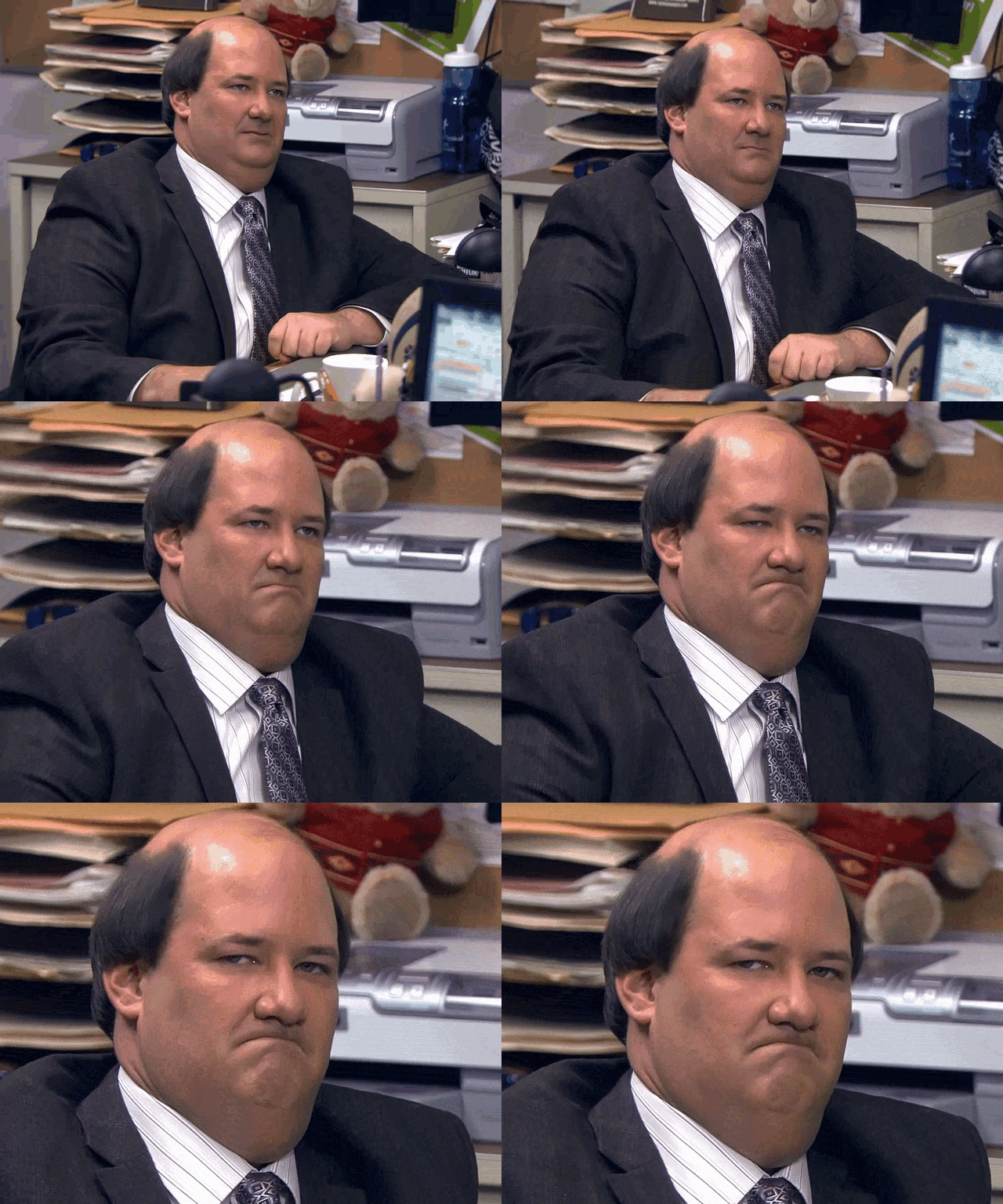
On our map, Kevin and Angela are polar opposites in nearly every trait. Where Angela is high on the Reserve scale, keeping her thoughts and private life under a heavy lock and key, Kevin is almost entirely transparent. Kevin’s lack of Orderliness and lower Intellect may be what fuels the signature Kevin look, but they are also the direct friction points that make Angela’s life miserable. If Kevin were even slightly more organized or “proper,” half of Angela’s dialogue and her constant state of agitation would simply vanish. It turns out that “accounting for taste” is impossible when one person is a perfectionist and the other is just trying to finish their chili.
The HR Wall and the Rest of the Office
Mapping Toby Flenderson (grey) reveals exactly why Michael harbors such vitriol for him. Toby has a subdued, high-Reserve, and low-Assertiveness profile. Michael’s high Emotionality triggers whenever he hits Toby’s wall of calm, HR-mandated neutrality. Michael sees Toby’s lack of Gregariousness not as a personality trait, but as a personal attack on the fun atmosphere he tries to force on everyone.
Then there is Stanley Hudson (green), who defines the extreme end of Introversion and Reserve. He wants to do his crossword and go home. On the other hand, you have Kelly Kapoor (pink), who rivals Michael in Gregariousness and Social Confidence. The office works because for every person trying to be the center of attention, there is someone like Stanley or Toby trying to disappear into the background.
Engineering Conflict for Your Own Stories
For writers, The Office teaches us that you don’t need a high-stakes plot if you have a cast that covers the whole spectrum of personality colors. When you map your characters on 16Core Character Mapper, you start to see where the “white space” is. If everyone in your story is high on Social Confidence, who is the one feeling awkward in the corner? If your protagonist is high on Distrust, who is the “Kevin” that is going to drive them crazy with their openness?
By visualizing these traits, we stop writing types, and start writing people. The Scranton branch isn’t just a place where employees sell paper; it’s a psychological landscape where every character’s unique personality is constantly bumping into someone else’s.
Download 16Core Character Mapper for free: georgetsirogiannis.com/16corecharactermapper