

In Westeros, Character Is Plot: How Traits Drive the Chaos
A visual breakdown of character dynamics in Game of Thrones using 16Core Character Mapper

Most discussions about Game of Thrones focus on the Game: the power plays, the backstabbing, and the high-stakes politics. But if you strip away the crowns and the castles, you’re left with a collection of volatile personalities forced into the same tight spaces. The drama in Westeros flows directly from the fact that these characters are psychologically wired to clash, making their eventual descent into chaos feel less like a series of plot points and more like an inevitable biological reaction.
There’s an axiom in screenwriting: character is plot. In Westeros, this is literal. The War of the Five Kings is triggered by Littlefinger’s machinations and Joffrey’s cruelty after King Robert’s death, but at a deeper level, it escalates because one man’s rigid sense of duty cannot coexist with another woman’s deep-seated distrust.
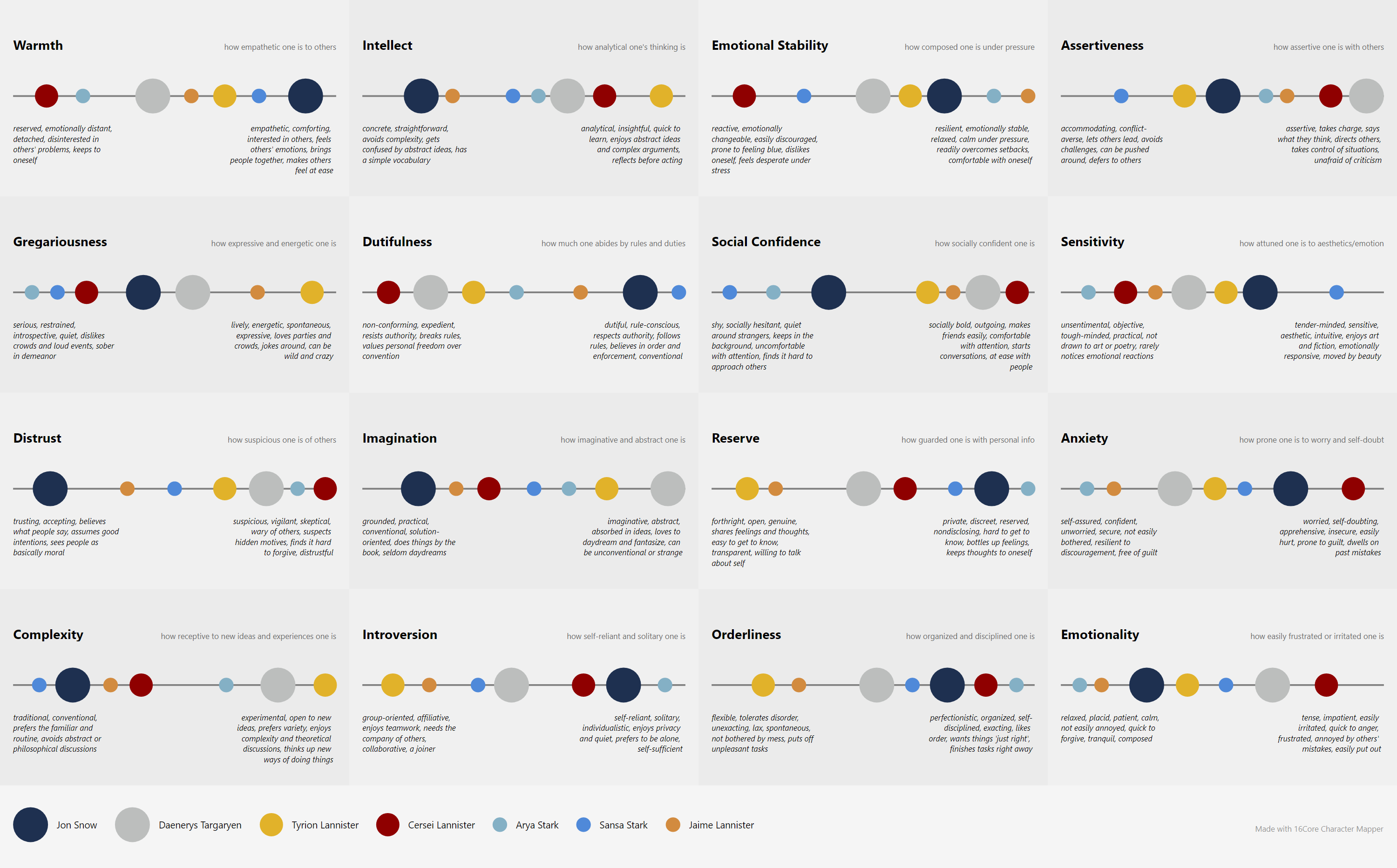
Through 16Core Character Mapper’s trait grid, we can see the invisible reasons why some alliances flourished and why others were doomed to burn. For this analysis, we’ve chosen the characters who drive the central conflicts after Rob Stark dies in the Red Wedding and the Boltons seize control of the North.
While the map below represents their core dispositions during the first three seasons, the tragedy of the story lies in how they desperately try to outrun their own internal settings.
And mostly fail.
The Environmental Forge: Wealth vs. Winter
One of the strongest aspects of George R.R. Martin’s world-building is how environment and wealth shape the expression of character traits.
In the North, the Starks—Jon Snow (navy blue), Sansa (light blue), and Arya (slate grey)—are forged by relative scarcity and the constant threat of winter. This geographic exposure necessitates a baseline of Dutifulness and Orderliness. For the Starks, these are survival mechanisms. If the North doesn’t follow a code, the North dies.
We see this most vividly in Sansa. While often criticized for her passivity in early seasons, the map reveals this is actually extreme Dutifulness in action. She survives King's Landing not by resisting, but by adhering strictly to the rules of the court. She does exactly what she’s told, no matter how much she suffers.
However, as this is paired with extremely high Reserve, she almost never speaks her true feelings, hiding her hatred for Joffrey behind a mask of courtesy. She is a vault, opening up only rarely to the few people she trusts.
Contrast this with the Lannister DNA. Cersei (red), Tyrion (gold), and Jaime (copper) grew up in the immense wealth of Casterly Rock, with their father serving as Hand of the King for years. Wealth in Westeros acts as a psychological buffer; it allows the Lannisters to express extreme Social Confidence and Assertiveness without immediate consequences. They don’t need to be Dutiful to the social contract because, for a long time, they owned the contract. This privilege breeds a dismissive attitude toward authority, allowing them to operate with low Dutifulness scores that would get a lesser house executed.
The Visionary vs. The Paranoid: Daenerys and Cersei
At a glance, Daenerys Targaryen (light grey) and Cersei might seem like two sides of the same coin: both are high-stakes players with high Assertiveness. But when we look at the map, the roots of their power are worlds apart.
During her ascent in the East, Daenerys sits at the extreme high end of Imagination and a significantly high level of Complexity. Her plan to liberate slaves to build an army is a complex, novel solution to a traditional problem. She’s a visionary, someone capable of “breaking the wheel” and imagining a world that doesn't exist yet.
Her eventual descent into the darker aspects of her arc, though, is foreshadowed by her combination of high Emotionality and Imagination without that final, absolute tier of Emotional Stability that would allow her to stay calm and composed when things go south. Because she has a messianic vision (high Imagination) but lacks the ultra-high Emotional Stability that would help her adapt when the world refuses to fit her idealistic mold, she finally defaults to the most decisive trait she has left: Assertiveness backed by fire.
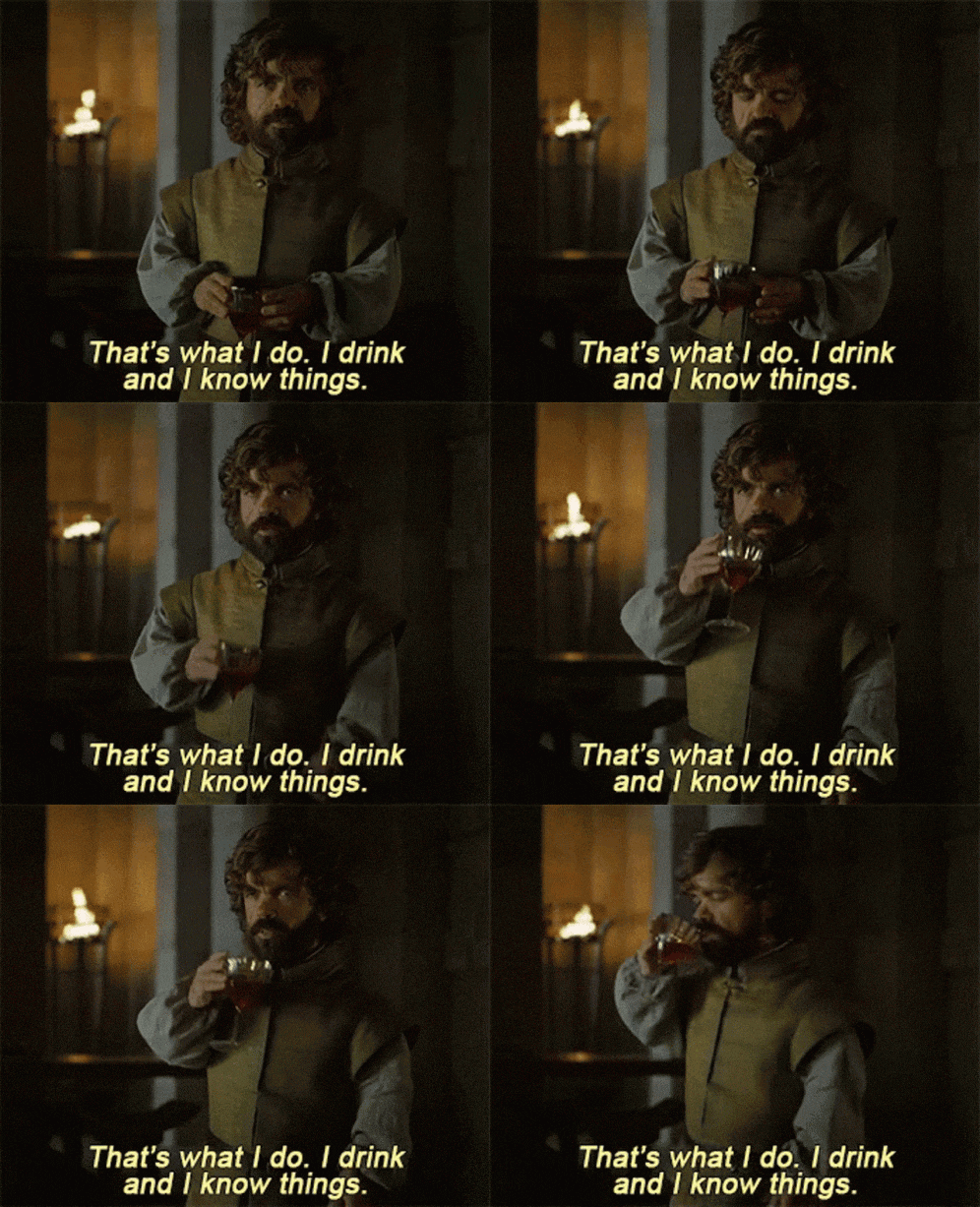
Cersei, on the other hand, operates from a place of high Anxiety, extreme Distrust, and notably high Introversion (indicated by the numerous times we catch her drinking alone, staring at the sea, needing the space to regroup1). Her actions aren’t born of a grand plan for the future, but from a volatile, defensive need to protect what’s hers in the present. While Daenerys is looking at the horizon, Cersei is hyper-focused on the shadows in the corner of the room.
Which makes their collision inevitable. One wants to build a new world because she can imagine it, while the other is willing to burn the current one down just to feel safe for one more night.
The Tyrion Anomaly
The most interesting case on our map might be Tyrion Lannister. He possesses the Lannister high Social Confidence, but it’s tempered by a unique combination of high Complexity, quite high Distrust, and—crucially—unusually high Warmth for a man of his station.
This specific cocktail explains his survival. His high Distrust keeps him alive in King’s Landing, while his high Complexity allows him to solve problems that baffle more rigid thinkers. However, we see his effectiveness wane in the later seasons as power becomes more centralized.
Tyrion is a creature of the marginalized. He excels when he has to use his Complexity to navigate around obstacles. But later, when he becomes the establishment (Hand of the Queen), his high Warmth and Sensitivity start to act as liabilities. He begins to over-intellectualize his enemies, assuming they will act with the same logic he would. Worse, his Warmth makes him spare Cersei repeatedly, believing she'll send troops north, when a more ruthless advisor would have eliminated the threat.
Which leads to his late-game strategic failures. The brilliant tactician who survived King’s Landing becomes the advisor who can’t seem to get anything right. Same person, different context, completely different results.
The Moral Anchor: Jon Snow
Jon Snow is the map’s anchor in Dutifulness and Orderliness. He’s probably the most traditional character in the cast, leaning low on Complexity. In the context of 16Core Character Mapper’s framework, being low in Complexity isn't necessarily a bad thing; it means he sees the world in clear, straightforward terms. Right is right, wrong is wrong. The Night King is coming.
For Jon, the world is governed by rules, honor, and sacrifice. While this makes him a reliable leader, it also highlights his greatest weakness: he is far too high in Warmth and too low in Distrust for the world he lives in. His high Emotional Stability keeps him stoic under pressure, but his lack of Complexity often leaves him blindsided by the grey morality of people like Tyrion or Littlefinger. He expects people to keep their word because he keeps his—a psychological blind spot that nearly costs him everything.
The mutiny at Castle Black. The parley beyond the Wall. Trusting Cersei with the truth. Multiple times, his inability to suspect betrayal brings him to the edge of death.
Sibling Divergence and the Tragedy of Drift
Even within these families, the trait grid exposes the deep internal fractures that drive the show’s most intimate conflicts. By looking at how these siblings differ across just a few axes, we can see why they often feel like they’re speaking different languages despite being raised in the same halls.
The Lannister Wedge: The Burden of Kingslaying
The most striking divergence among the Lannister siblings is their relationship with Distrust and Anxiety. Cersei and Tyrion are both high on the Distrust scale; they operate in a world of constant suspicion, always looking for the hidden motive. But the map reveals a vulnerability in the Lannister brothers that often gets overlooked. Tyrion carries a significant level of Anxiety—the weight of his father’s eternal disapproval and the social stigma of his stature. This makes his wit a defensive tool as much as an offensive one.
Jaime, however, is the anomaly. He is significantly less Distrusting and lower in Anxiety. While he carries the psychological burden of being the Kingslayer, his lower score in Complexity means he processes this trauma through a more straightforward, soldierly lens. Jaime is a man of the battlefield, where camaraderie is a necessity. This makes him the only Lannister truly capable of unguarded connection (seen in his bond with Brienne) but it also makes him the blind spot in the family’s Machiavellian system. While Cersei is playing 3D chess against shadows, Jaime is often operating on a direct, emotional level that his siblings find baffling, or even dangerous.
The Stark Divide: Tradition vs. Transformation
The contrast between the Stark sisters is perhaps the most extreme on the entire map, specifically regarding Social Confidence and Complexity.
In the early seasons, Sansa is the paradigm for Dutifulness and Sensitivity, but she sits at a near-zero for Complexity. She is a pure traditionalist; she believes the songs, follows the rules of ladyhood to the letter, and lacks the intellectual curiosity to question the system. Her low Social Confidence makes her the perfect “bird in a cage”, terrified to step out of line. To her, the court of King’s Landing is the dream she was built for, even when it turns into a nightmare.
Arya, meanwhile, is the only Stark who breaks the mold with a high Complexity score. While she shares the family baseline of Reserve, her mind is wired for experiment and rebellion. She rejects the chivalric code that Sansa worships, seeing it as a prison rather than a dream. This high Complexity paired with high Assertiveness is what allows her to survive as a fugitive; she can imagine herself in different roles, eventually leading her to the ultimate “out of the box” thinking: becoming No One.
Finally, we have to acknowledge the tragedy of character drift. While this map represents their starting positions, the story’s drama comes from watching these characters be violently dragged from one side of the trait lines to the other. We eventually see Sansa forced on a brutal march up the Distrust and Complexity scales—a total overhaul of her personality, just to survive. Seeing a character forced to kill their natural Warmth or Sensitivity to stay alive is the true psychological tragedy of Westeros.
Why Character Mapping Matters for Your Story
When we see these characters mapped out, we stop seeing them as “good” or “bad” and start seeing them as a series of levers and pulleys. If you’re writing a scene and it feels flat, ask yourself: Are these two characters too similar?
Two characters with high Dutifulness and low Distrust will essentially be a mutual admiration society, trusting everyone and following every rule until they are both executed (or until the audience is bored to death). But toss a high Dutifulness character (like Jon Snow) in a room with a high Distrust, low Dutifulness character (like Cersei)? The scene writes itself.
Westeros is a bloody place, but the blood only spills because the people involved have nowhere else to go. Their traits are the walls of the maze. Or maybe the maze itself. Either way, they're trapped.
If you want to see how your protagonist's traits clash with your antagonist's, you can download 16Core Character Mapper. It's a simple, free way to visualize your characters' psychological makeup and ensure your character DNA is driving your plot forward.
High Introversion in our 16-trait framework serves as an energy direction indicator, and defines a character who values privacy and quiet. It doesn’t imply hermit behavior per se.